Skip to content
The Garage Archive

Stories the old cars still tell.

A personal history project — a small, slow-growing archive of stories about classic automobiles and the people who kept them on the road.

These stories are works of creative fiction inspired by real automobiles — written to honor the machines and the people who loved them. The accompanying illustrations are AI-generated artistic renderings, not photographs of real vehicles.

Birmingham, Alabama, 1971 · As remembered by a machinist's daughter, forty years on

The Car My Father Brought Home

1967 Ford Mustang Fastback
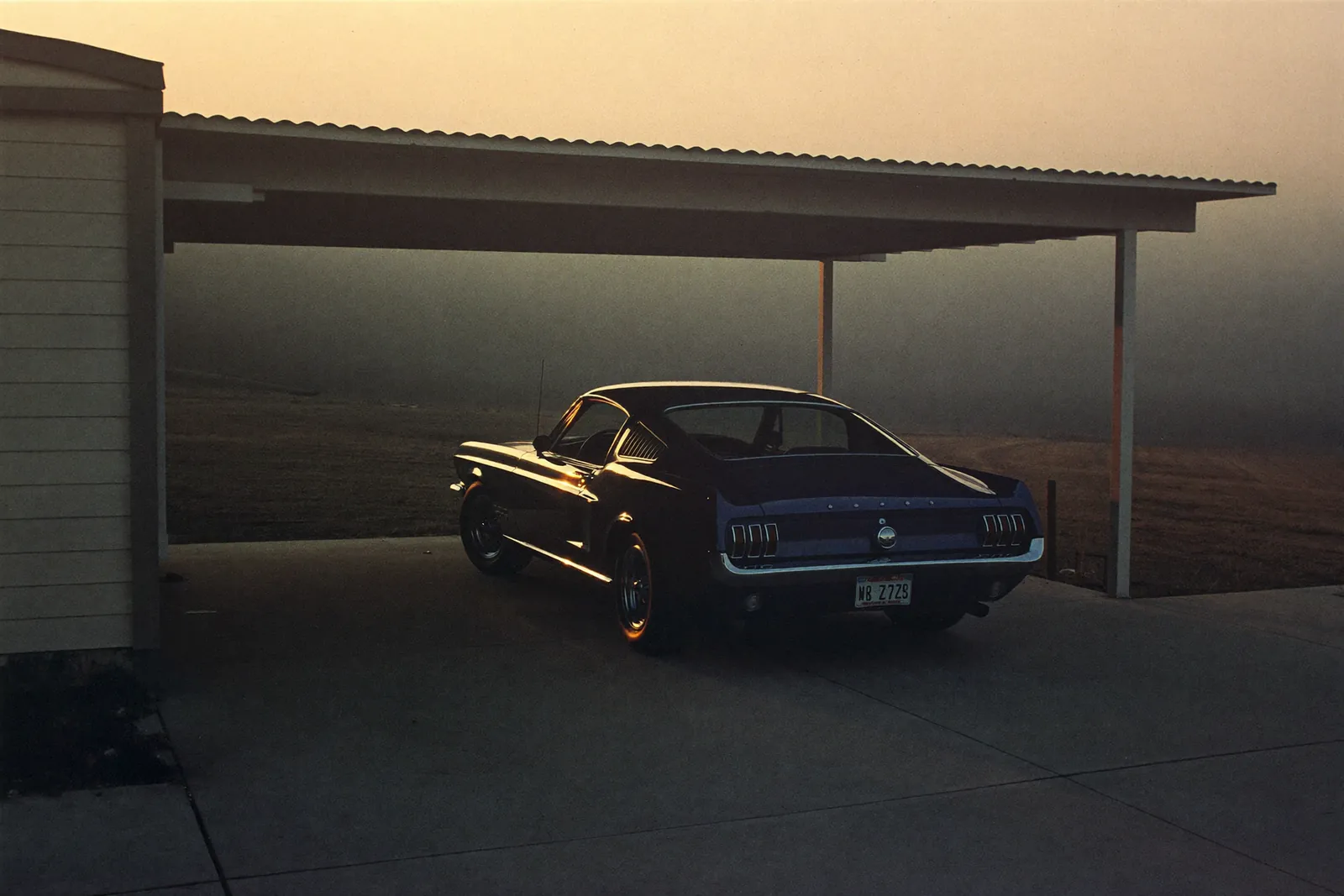
AI-generated illustration: a dark blue 1967 Ford Mustang fastback parked under a carport at dusk, long shadows on the driveway.

The summer my father brought home the Mustang, I was eight years old and the heat sat on Birmingham like a thumb. He pulled it into the carport on a Tuesday evening, and I remember the tick of the engine cooling while we all stood in the driveway not saying anything. My mother pressed her lips together. My brother counted the louvers on the rear quarter panel. I just looked at the fastback roofline — that long, descending slope — and thought it looked like something that wanted to leave.

He never explained the color — Nightmist Blue, the kind of deep blue that looks black until the sun insists — but I understood later that he had chosen it the way a man chooses something he believes he doesn't deserve.

That car smelled of vinyl and something faintly chemical, a factory smell that never fully left it. On hot afternoons the interior would build to a temperature that was almost punishing, and the steering wheel was too hot to hold with bare hands. We drove to Tuscaloosa once, my father and I, and he let me rest my arm out the window while the wind took my elbow and held it. The 390 cubic-inch engine moved us down the highway with a sound that was less a roar than a low, constant argument with the road.

He kept that car eleven years. Waxed it Saturday mornings in the driveway with a chamois cloth, working in circles. He never entered it in any show, never invited anyone to admire it. It was not that kind of car to him.

When I was nineteen he sold it to a man from Anniston who restored old Fords. My father shook the man’s hand in the driveway and watched him drive away, and then went inside without a word. I think he had decided, finally, that he did deserve it — and that realizing so had made it possible to let go.

I have never owned a Mustang. But I still notice them when they pass, that roofline, and I still think: something that wanted to leave. Something that waited, instead.

He never explained the color — Nightmist Blue, the kind of deep blue that looks black until the sun insists — but I understood later that he had chosen it the way a man chooses something he believes he doesn't deserve.

Stuttgart and Salzburg, 1958–1961 · As reconstructed from letters written by an Austrian engineer's apprentice

The Flat-Four at Four Thousand

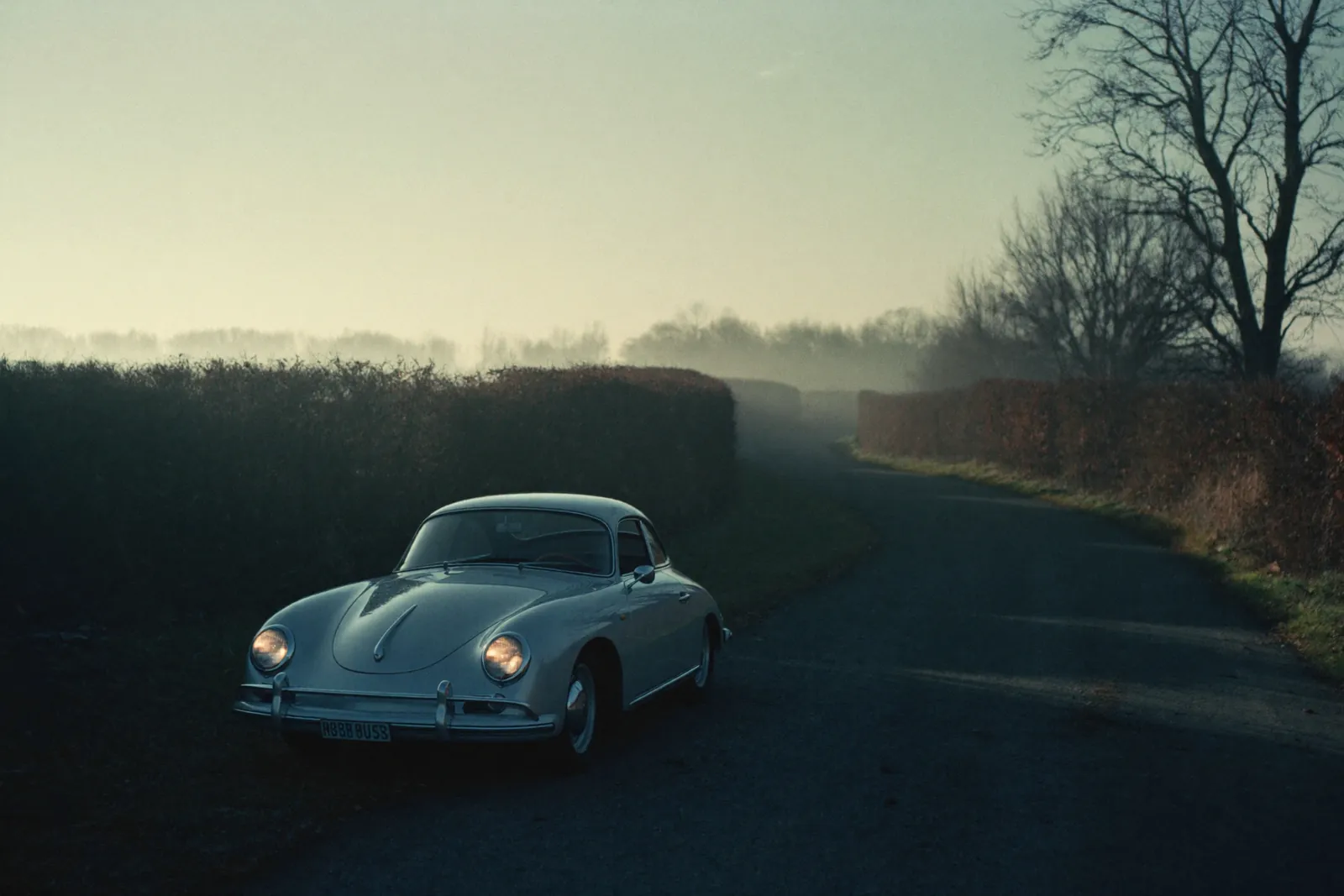
Porsche 356 (late-1950s)

AI-generated illustration: a silver Porsche 356 coupe on an empty alpine road in October morning fog.

My employer drove a silver 356 coupe that he had purchased in 1958, and for three years my understanding of what a car could be was formed entirely by proximity to that machine. I was eighteen when I came to work in his office in Stuttgart. I had grown up around trucks, agricultural equipment, things built to bear weight and absorb punishment. The Porsche was nothing like that. It was an argument in aluminum and glass.

The body sat low and rounded, almost without angles — the designers had followed air rather than fought it, and the result was a shape that seemed to belong to the road the way water belongs to a channel. In the morning light the silver paint held the color of the sky above the Salzkammergut, which is to say it held several colors at once and committed to none of them.

At four thousand revolutions per minute the engine found a note — not a roar, nothing so uncomplicated as that — a sustained, reedy keen that sounded like intention itself. The flat four-cylinder engine sat behind the rear axle, an arrangement that gave the car an eagerness at the front and a particular responsiveness in corners that my employer explained to me on an empty road outside Salzburg one October morning, the hedgerows brown and the air carrying an edge.

He was not a sentimental man. He did not name the car or describe it in terms that required your indulgence. He said only: it does what you ask, if you know what to ask. I wrote this down in my notebook and thought about it for a long time.

I left his employ in 1961 and did not drive a Porsche again for many years. When I did — a different car, a different decade — I recognized something immediately, a quality of communication between machine and road that had apparently been present all along in that silver coupe, waiting for me to develop the vocabulary to name it.

My employer sold the 356 before I left. He shook hands with the buyer and returned to his office without sentiment. I watched from the window as the car moved down the street, that rounded silver shape, and understood I was watching something irretrievable — not the car exactly, but the period of not yet knowing what I now knew.

Some educations cost nothing. Some cost exactly that.

At four thousand revolutions per minute the engine found a note — not a roar, nothing so uncomplicated as that — a sustained, reedy keen that sounded like intention itself.

Pasadena, California, 1959 · Told in the voice of a retired copywriter, circa 1997

Sunday in Pasadena

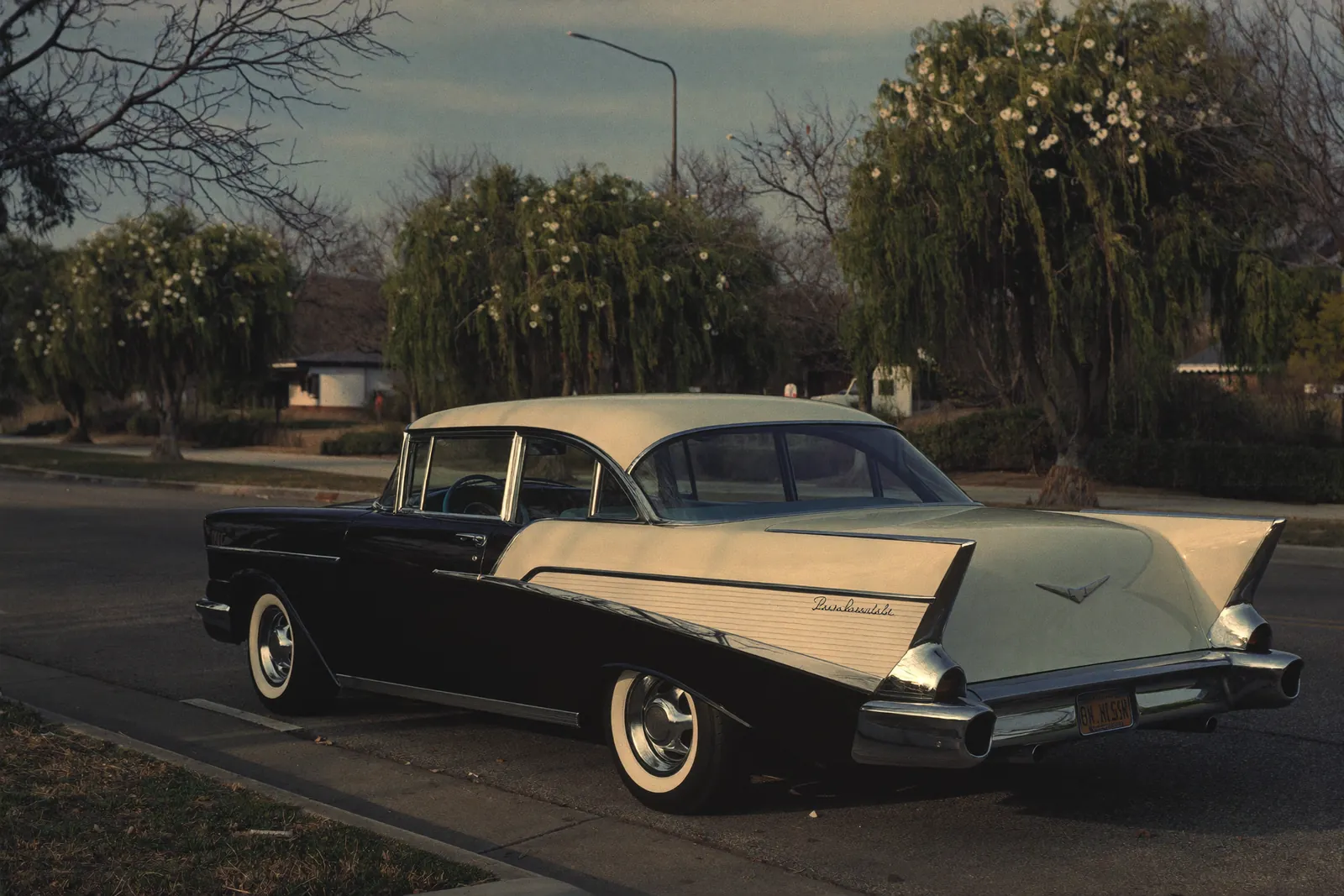
1957 Chevrolet Bel Air

AI-generated illustration: a black-over-ivory 1957 Chevrolet Bel Air with chrome tail fins on an empty tree-lined boulevard in morning light.

Let me be honest about the Bel Air: it was too much car. This was the general condition of American automotive design in 1957, and the Bel Air was its most cheerful example. I bought mine secondhand from a pharmacist in Glendale who had kept it so clean you could have performed minor surgery on the hood. I was twenty-four. I had recently discovered that advertising paid reasonably well and that Pasadena on a Sunday morning was the finest place on earth.

The fins were, objectively speaking, absurd — two chrome-tipped blades jutting from the rear like the ambitions of a civilization that had not yet encountered consequence. I loved them unreservedly. I loved the two-tone paint, Onyx Black over India Ivory, and I loved the way the chrome trim caught the light on Colorado Boulevard at eight in the morning when the street was still empty and the air smelled of jacaranda and someone’s coffee.

The V8 was not subtle. Nothing about that car was subtle. When you started it on a cold morning the whole thing shuddered once, like a large animal shaking off sleep, and then settled into an idle that you felt in your back teeth. People talk about cars as though restraint were a virtue. The Bel Air held no such opinion.

I drove a girl named Frances to Santa Barbara in it that autumn. She wore a yellow scarf and held it against the wind with both hands the whole way up the coast highway. I do not know what became of Frances. I know exactly what became of the car: I sold it in 1963 to pay for a furniture deposit, a decision I have reconsidered perhaps once a week for the past thirty-four years.

What I miss is not the spectacle of it — though the spectacle was considerable — but the specific quality of light on those Sunday mornings, the way the world looked navigable from behind that wide steering wheel, the particular confidence of driving something that had made up its mind completely about what it was.

The pharmacist had been right to keep it clean. Some things deserve that kind of attention.

The fins were, objectively speaking, absurd — two chrome-tipped blades jutting from the rear like the ambitions of a civilization that had not yet encountered consequence.

Carmel-by-the-Sea, California, 1968 · As told by the original owner's daughter

The One They Kept Looking At

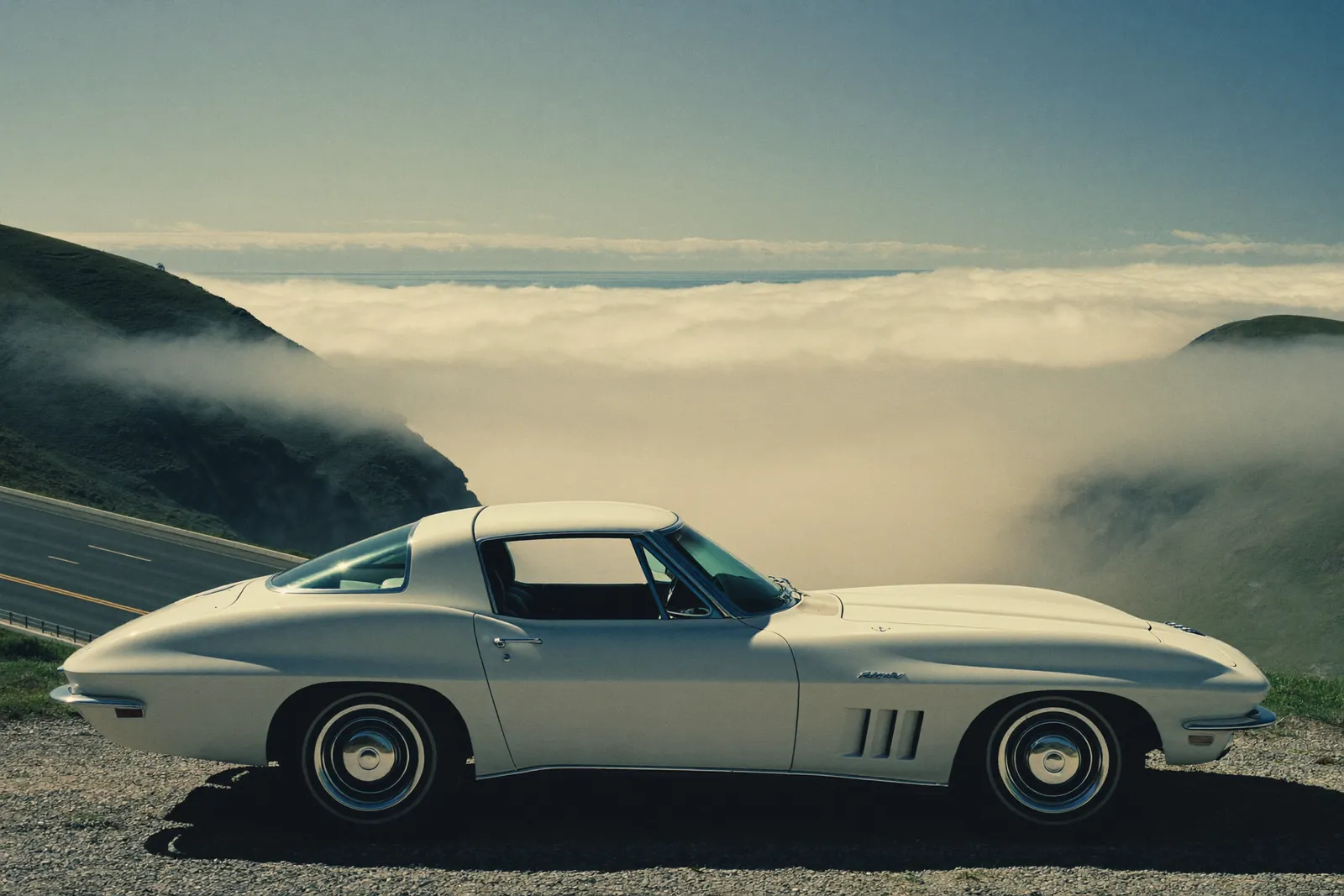
1963 Chevrolet Corvette Sting Ray

AI-generated illustration: a white 1963 Chevrolet Corvette Sting Ray split-window coupe at a coastal highway pullout with fog over the headlands.

My father bought the Sting Ray in the spring of 1963 from a dealership in Salinas, and he drove it home at thirty-five miles an hour the entire way. My mother, following in the family sedan, said she spent forty minutes watching that rear window.

The split window — the spine of glass dividing the fastback into two panes — was already controversial by the time he bought it. Bill Mitchell wanted it; the engineers hated it for the blind spot. By 1964 it was gone, smoothed away into a single piece. My father used to say he'd bought the argument, not just the car. He seemed proud of that.

It lived in a garage that smelled of cedar and 10W-40. He washed it on Sunday mornings with a chamois he kept in a coffee can, working from the roof down in long careful strokes, never letting the water sit. The Ermine White paint had a depth to it that changed with the fog rolling off the bay — chalky in flat light, almost luminous when the sun broke through.

He rarely drove it more than twenty miles. There was a stretch of Highway 1 south of town where the ocean appeared suddenly between two hillsides, and I think he drove there to watch the car arrive in that frame. He would slow nearly to a stop. Once, a man in a pickup pulled alongside and just nodded, slowly, the way you nod at something you recognize as serious.

When I was seventeen I asked him why he never took it on a long trip. He thought about it longer than the question seemed to deserve. 'Because then it becomes a trip,' he said, 'and not the car.' I didn't understand that for years.

He sold it in 1974, during a difficult year, to a dentist in Pebble Beach who promised to keep it original. I hope he did. What I remember is standing in the driveway watching the new owner drive away, and my father standing beside me with his hands in his pockets, not watching the car go — watching the empty street after it had already turned the corner, as if he were memorizing the absence.

He never drove it fast. I think that was the whole point.

Outside Flagstaff, Arizona, 1971 · As told by a former schoolteacher

Thirty-Two Thousand Miles of Gratitude

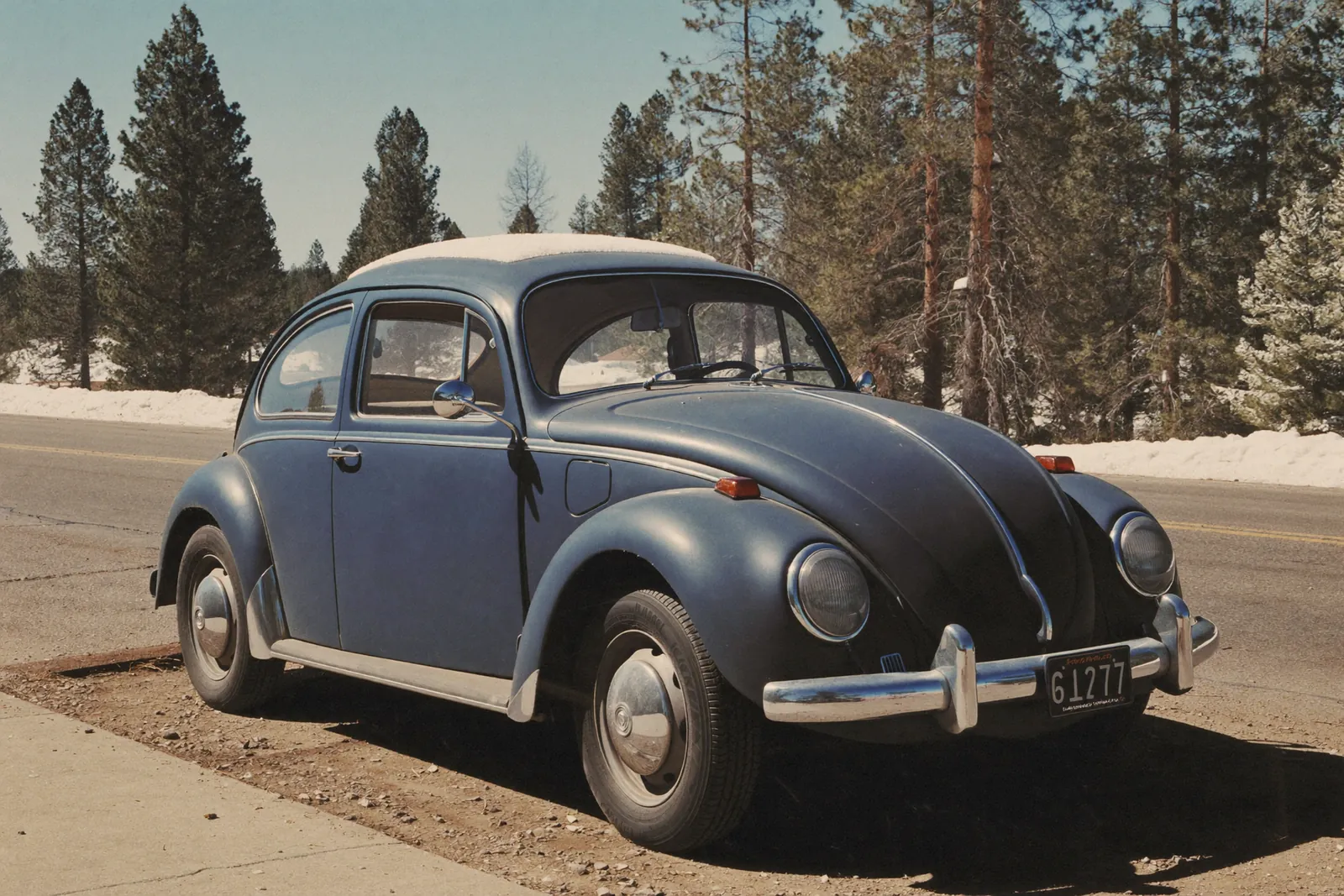
1967 Volkswagen Beetle

AI-generated illustration: a dusty blue 1967 Volkswagen Beetle parked beside a snowy pine road in thin winter light.

I paid three hundred and forty dollars for it from a geology student at Northern Arizona University who was moving to Portland and claimed, unconvincingly, that it ran fine. It ran. Fine is a word I would use loosely.

The 1967 had the air-cooled flat-four in the rear, which meant the engine noise lived directly behind your head like a very committed small appliance. In winter, which in Flagstaff is most of the year, the heater — such as it was — pulled warmth off the engine through a set of ducts that I came to think of as a suggestion rather than a system. I wore a coat. I wore two coats. The car was not embarrassed about this.

It was Zenith Blue, a color that sounded more distinguished than it looked, which was a medium dusty blue that faded toward gray in strong sun. The chrome on the bumpers had gone soft in places. The previous owner had replaced the shift knob with a billiard ball, and I never changed it because it turned out an eight-ball is an excellent shift knob.

What I did not expect was how the car made strangers talk to me. Gas stations, parking lots, the long diagonal space outside the grocery store — people approached it the way people approach dogs, with an opener already ready. An older man in Winslow once spent twenty minutes telling me about a Beetle his sister had driven across New Mexico in 1962, and he was laughing by the end of it, and so was I, and we had never met before and never met again.

I taught fourth grade. I drove forty minutes each way on a road that had opinions about itself in March. The Beetle never complained in any language I recognized as complaint — it just made its sounds, used its fuel sparingly, and arrived. I began to feel, not gratitude exactly, but something in that neighborhood. The acknowledgment that a thing is doing its job without requiring your sympathy.

I sold it after seven years to a young woman who needed transportation and said she'd always wanted one. I showed her how to check the oil, where the jack lived up front, which of its sounds were conversation and which were complaint. She nodded seriously. Driving away from my house she gave a small wave without looking back, already committed to the next thing, and I thought: that's right. That's exactly right.

It heated up eventually. You just had to be patient with it, which I suppose it was also teaching me.

The archive grows as the stories find us.